“I’m proud of you”

Transitioning from incarceration to the community is riddled with barriers. A prior conviction can severely limit or cut off a person’s access to employment, civic rights, loans, public benefits, and, of course, housing. In fact, a 2024 study found that 1 in 4 people who were released from North Carolina prisons were released into unsheltered homelessness — not to temporary housing, a shelter, or a treatment program — but right onto the streets[i]. 64-year-old Jenna knows this experience all too well.
Jenna did not have a place to live when she was released from prison. She was estranged from her two sons, and both of her parents had passed away while she was in prison. Thankfully, Jenna was given the opportunity to move to Asheville and live at ABCCM’s Transformation Village, a transitional housing shelter.
Jenna, who is independent and driven, was quickly able to meet her goals once she had shelter. Three days in, she had a job. Three months in, she had a car. Three and a half months later, Jenna found and moved into her own apartment.
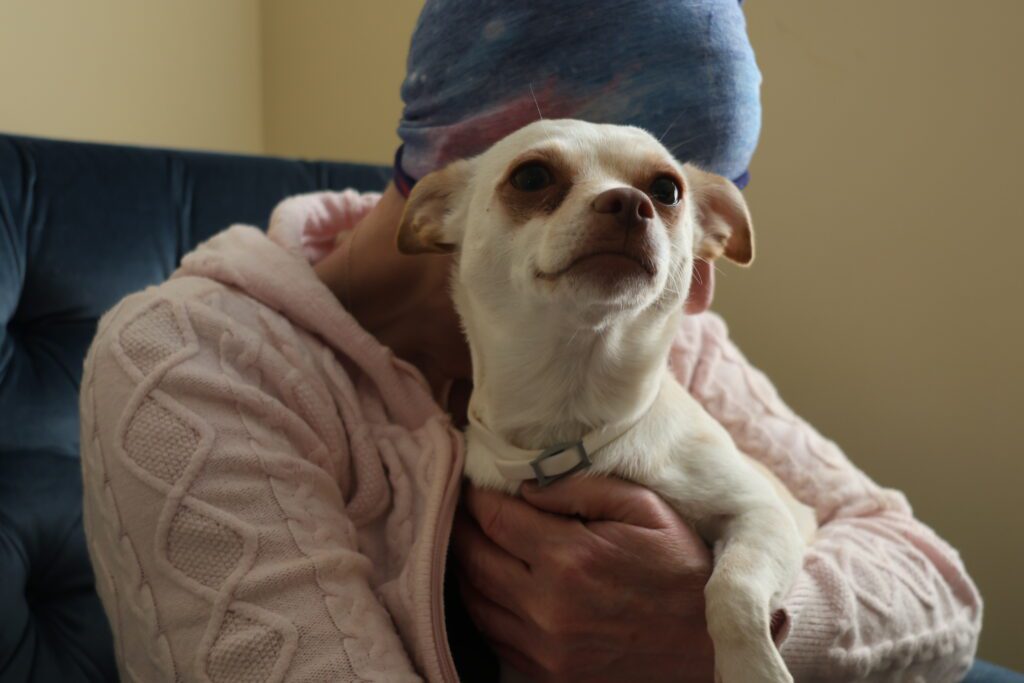
Unfortunately, Jenna lost the housing she had worked so hard to find when Hurricane Helene destroyed her apartment. Jenna was now competing to find a new home along with thousands of other people in WNC whose homes were damaged or destroyed. However, Jenna’s prior conviction made it almost impossible. She and her dog, Daisy, lived in a hotel until the cost was too much to maintain. She tried to receive FEMA assistance with no luck. Then, Jenna suffered another major setback: a head-on collision that totaled her car and currently impacts her physical abilities.
“It was just downhill from there,” says Jenna. “I couldn’t take care of us, so we started living outside. That’s a horrible life.”
Nicole, one of Homeward Bound’s Street Outreach Case Managers, saw Jenna with a backpack and her dog, Daisy, and approached her, asking if she was experiencing homelessness. Nicole asked Jenna if she knew about Homeward Bound’s Rapid Rehousing program, which was recently expanded to help rehouse Buncombe County residents who lost their housing due to Helene. For Jenna, this support seemed out of reach because of her conviction.
“I filled out the application with Nicole, and I told her, ‘They’re not going to let me have it because of my past.’ Nicole said, ‘This has nothing to do with that.’ I said, ‘They’re not going to care? I can’t get an apartment, and nobody will rent to me. It was a block everywhere I went. The only way I got the first apartment was through an individual person. I could talk to them. These days everything is through corporations. You can’t explain to people ‘this happened all these years ago.” It’s not personal anymore. I had the money to live somewhere. I just couldn’t get in.”
Homeward Bound believes in the stability of housing, and so she was approved for short-term rental assistance and support through our Rapid Rehousing program.
Today, Jenna and Daisy have lived in their apartment for over four months.
“This program has saved us, and if it wasn’t for Daisy, I don’t know. If I hadn’t had her out there going through all of this, I don’t know what I’d have done. Then along came Nicole and Lindsey [her Housing Case Manager], and they got to us and got us here. I was at the end of my ropes. I just couldn’t do it anymore, living afraid like that. I’m not a lazy person; I am very independent and strong-willed, and I have always done for myself. But this has given me the opportunity to not have to stress over where I’m going to stay, or if I’ll have something to feed Daisy.”
Jenna is still recovering from her car accident, which makes it hard to walk or even lift her head. She works remotely as an accountant and says the pay is “nothing major, but it keeps me to where I can live life and pay my bills.”
“There’s no way I could have done it myself, no matter how many little jobs I had. It’s just hard to get going. And when people won’t give you an opportunity, and you have to go down other avenues, that just makes it harder. I can see why there are a lot of people who go back to prison[ii]…There are not enough programs for women coming out of prison, other than straight into a rehab, when they really just want to live.”
Jenna and I talked about how she spent her recent holidays, which she says were nice. She made a Thanksgiving dinner for her friends and neighbors, and had her first Christmas tree. She’s also reconciling her relationship with her oldest son, who has a family of his own. He sends her photos of her three grandsons, whom she hopes to meet one day. But one thing she holds onto was a conversation they had when she told him about all the things she’s gone through and how far she’s made it, through her own efforts and with housing and support.
“My son told me, right before Christmas — and I never thought I’d hear him ever say these words — he said, ‘I’m proud of you.’ He said, ‘You don’t ask for nothing, you got here doing what you need to do.’ And that was worth it all. That was worth it all.”
[i] The Council of State Governments Justice Center. “Home After Incarceration: A Reentry Housing System Assessment in North Carolina” (2025)
[ii] Council on Criminal Justice. “Recidivism Rates: What You Need to Know” New National Recidivism Report