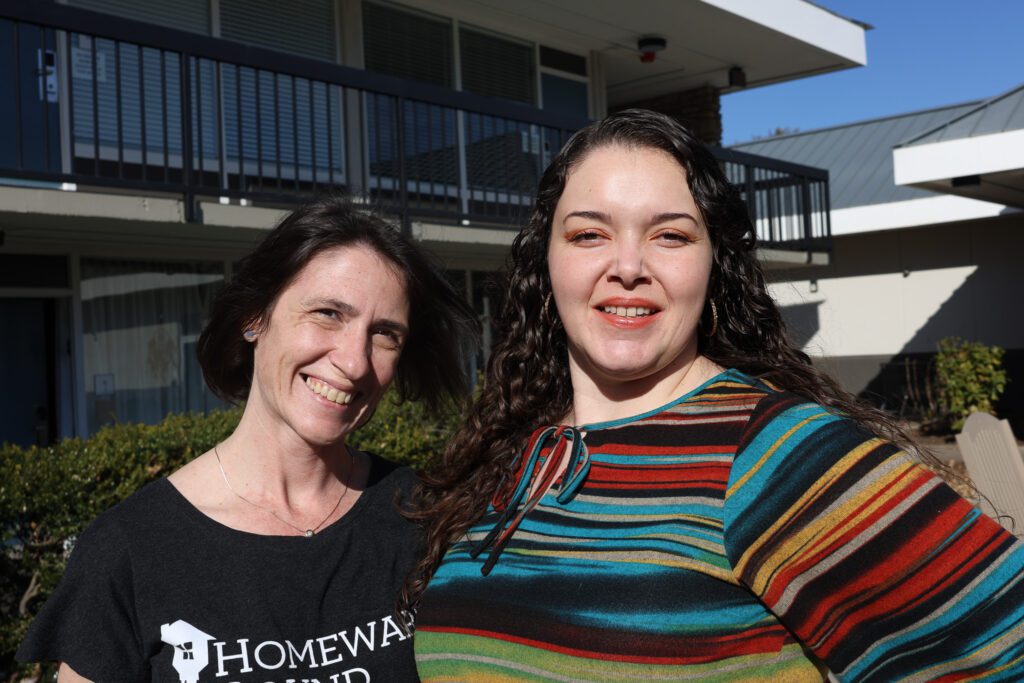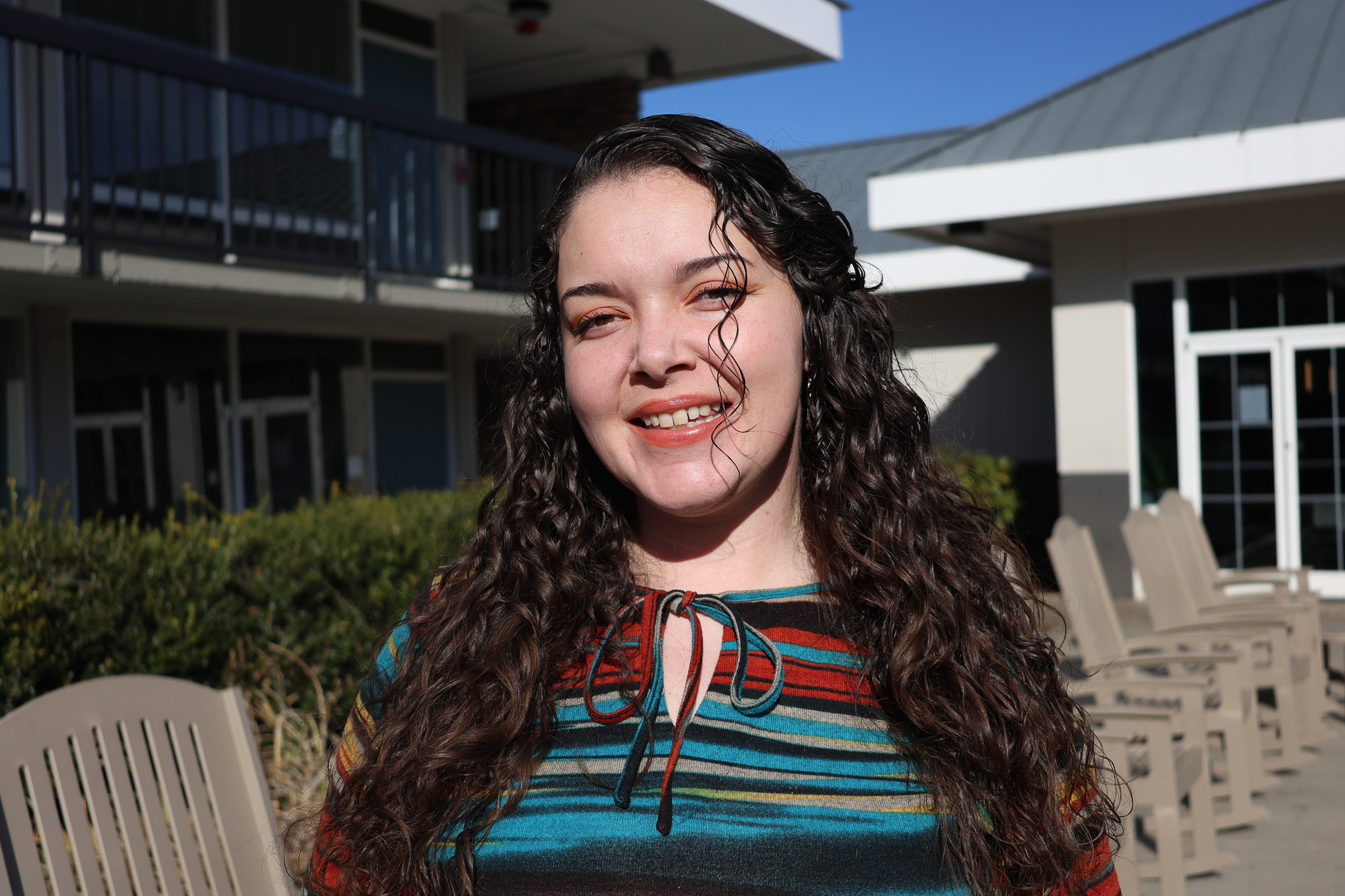
Tana is a strong and motivated individual who has felt like an adult since she was 11 years old. She is a survivor of domestic violence, forced institutionalization, homelessness, and other traumatic experiences—many of which were caused by people who were supposed to love and support her. Without consistent, early support systems, Tana faced ongoing barriers to housing, education, and stability. Her story reveals how intergenerational domestic violence and poverty play in the lives of many women and families experiencing homelessness.
Tana moved to Asheville with her mother and siblings in an effort to get as far away as possible from her violent and abusive father. At the time, the family was already living in a domestic violence shelter. When her parents’ divorce was finalized, the court determined that they needed to move at least four states away from her father for their safety.
Starting over in an unfamiliar place was restrictive and overwhelming, but Tana focused on school and supporting her family. Her mother worked and attended massage school while Tana took on summer internships and part-time jobs to contribute to rent. Eventually, she graduated from high school and was accepted into a college in Central Florida, achievements she says were hard to earn.
At 19, Tana began pursuing an associate’s degree in arts and science. However, after her first year, she lacked the financial resources to continue a second semester. During this time, she was living with a partner, someone she loved, who became abusive.
“As a child of domestic violence, it’s like I brought that over into my relationships,” says Tana. “It was normal.”
Tana’s first experience sleeping outside began when her partner would kick her out, leaving her to sleep in her car parked outside their home. Because his name was the only one on the lease, Tana had little control over her living situation. Her last remaining support system was her paternal grandparents, though they often sided with Tana’s father since the divorce. Nonetheless, Tana needed a place to stay and moved in with them. This is where things became increasingly unstable.
Tana’s paternal grandparents were deeply involved in a cult and its harmful practices, creating a fearful environment. One night, after reaching her breaking point, the police were called. Despite her attempts to explain what was happening, the police assumed that Tana was lying and involuntarily committed her to a mental health institution. This experience was devastating for Tana. For 20 days, Tana pleaded for someone to believe her as she learned she was at risk of being placed under conservatorship by a judge. Eventually, a staff member listened, believed her, and helped secure her release.
By that point, she wanted nothing to do with her grandparents and was unable to move back in with her mother. With no remaining support system to rely on, Tana became homeless. Over the next decade, she struggled with post-traumatic stress disorder and deep trust issues. Unfortunately, Tana experienced another traumatic experience when she attempted to reconnect with her father in hopes of having a place to stay. As a result, she fell into a downward spiral and developed an addiction to cope with the pain of her past.
Living on the streets in Asheville was extremely difficult. Tana stayed in abandoned buildings, in the woods, and with friends whenever possible. Over the years, she held jobs while homeless, including work as a certified nursing assistant and with a local city department. Despite her efforts, housing remained out of reach. Rent prices were unaffordable, and even motel rooms were often inaccessible due to policies that made it difficult for people with in-state IDs to book. Carrying everything she owned from place to place took a toll on her body and well-being.
“I can’t tell you the number of times that I had strap burns and backpack rub all against me just because I was trying to keep onto the few things that I had left.”

While experiencing homelessness in Asheville, Tana began visiting the AHOPE Day Center. There, she met AHOPE Program Manager Kris, who became a reliable and encouraging source of support. Through AHOPE, Tana was able to receive her mail, regain important legal documents, and access essentials like coffee, food, and showers. For the first time in a long while, Tana could see a real opportunity for stability and healing. In the summer of 2025, she received life-changing news: an apartment was ready for her at Homeward Bound’s Compass Point Village.
“This is the first time I’ve been on a lease,” shares Tana, reflecting on how difficult it became to find a home that was truly her own until the age of 30. “I’m starting to build some stuff back up. Things that bring me happiness and joy. Some of the things I have don’t have the sentimental value of the stuff I lost. I will never get back that beautiful scarf that I got while I was in France, I will never get my high school diploma back and the gifts from friends who passed away.”
She hopes her story encourages the Asheville community to reflect on how people experiencing homelessness are treated, particularly based on appearance. “People treat you differently when they see you and think that you’re a homeless person.” Without housing, maintaining hygiene was often difficult and deeply embarrassing. At times, she worked hard to stay clean so people would allow her to sleep on their couch, often washing up in gas station bathrooms.
Five months into her new home, Tana has the stability she needs to work toward her goals. She’s sober, searching for employment, and hopes to return to college to complete her degree, with the long-term goal of becoming a cosmetologist. While challenges remain—such as gaps in her resume due to years of homelessness—Tana remains determined. She is supported by several meaningful relationships, including her Case Manager, Amanda.
Despite the many challenges she has faced, Tana finds motivation from the glimpses of joy in her life. She remembers visiting France with her high school, driving across the country, and other meaningful moments that motivate her goals of rebuilding her life and traveling again.
“I’ve recentered myself,” shares Tana. “I tried not to let all the torture that I endured affect my mental health. I always tried to keep some goal alive or an aspiration to hold onto so that I didn’t lose my mind. I’m happy now that I have my own space where I can go to be recluse…I’ve got a home base.”
Statistics on intergenerational domestic violence and homelessness: Research shows that poverty and domestic violence often have intergenerational effects on families and their well-being. Studies estimate that up to 40% of children raised in violent households are at an increased risk of experiencing long-term trauma and becoming victims of domestic violence in adulthood[1]. Additional research shows that 10.7% of children born into poverty will spend at least half of their lives living in poverty.[2] Together, these findings reinforce that intergenerational poverty and violence are not the result of a single crisis, but of systemic factors passed down across generations.
[1] J. Kaufman et al. “Do abused children become abusive parents?” The American Journal of Orthopsychiatry (1987)
[2] Monica Privette-Black. “Intergenerational Poverty in the United States.” Ballard Brief. May 2021. www.ballardbrief.org.