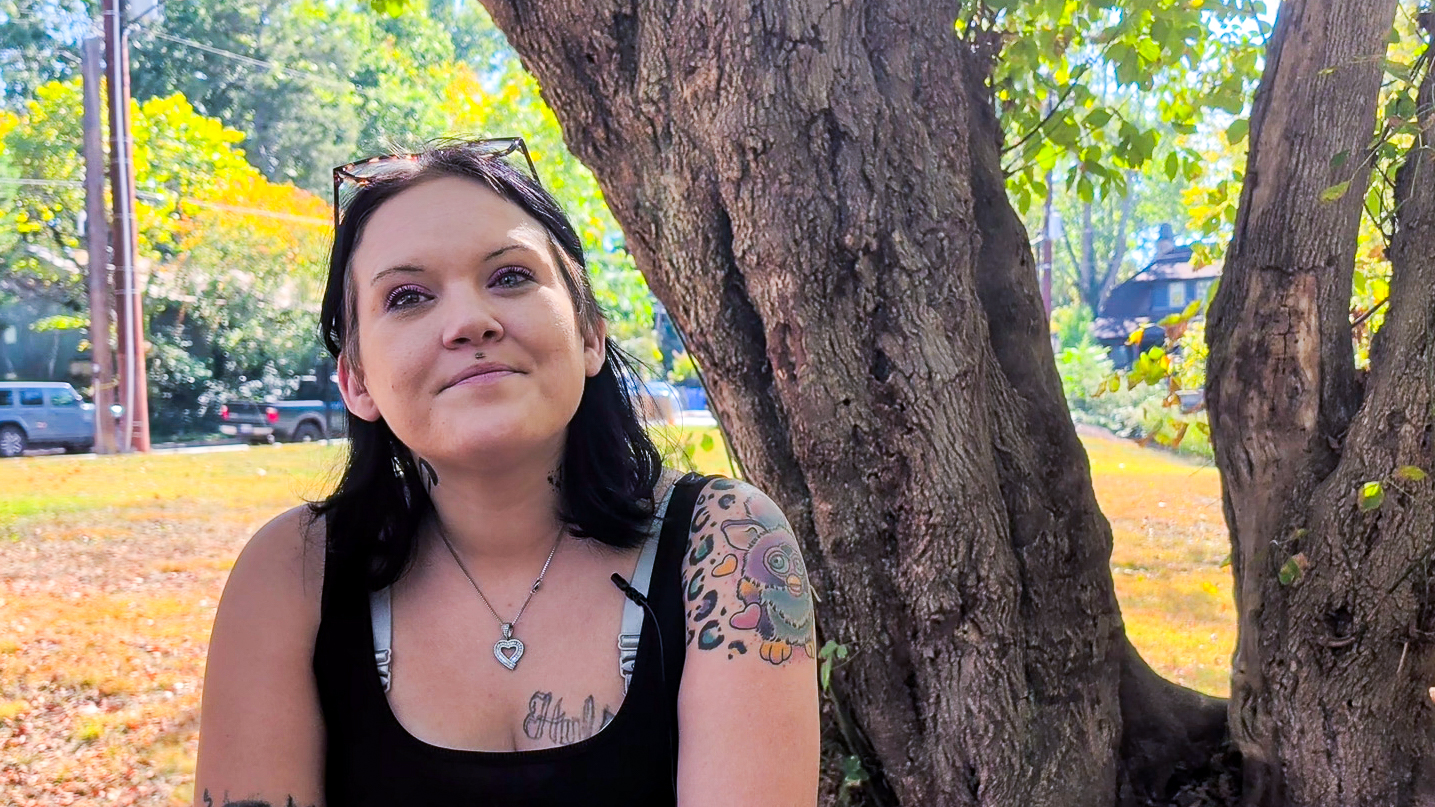
“When I was younger,” she says, “I didn’t care that I didn’t make it easy. But neither did they. They didn’t care that I made it hard.”
Ally was just seventeen when she found herself alone on the streets. Distrustful of institutions, she turned instead to the homeless community, relying on a group of people she calls her “lovely brothers,” who looked out for her and taught her how to survive.
For years, Ally pushed away people who tried to help. She felt unworthy of their support, unworthy of living a good life and struggled to imagine a different future. At times, she questioned whether there was a reason to keep going.
Over the next decade, Ally struggled to find stable housing. It wasn’t until she got sober in 2022 that things began to change. When she returned to AHOPE to begin a housing application, she discovered that staff had kept a file on her dating back to her teenage years.
Back then, she had refused to disclose her name or age, knowing that if staff identified her as a minor, they would likely try to contact her family, the last thing she wanted. Still, they had kept a record of her, labeled simply: “A” (possibly juvenile).
The file was still there, waiting for her when she returned.
Ally was part of the second group of residents to move into Compass Point Village, Homeward Bound’s permanent supportive housing community. There, she earned her GED, became a certified peer support specialist, and, at the urging of Debbie, the community’s Residential Manager, started a peer support group for residents.
“I still had all these people who were rooting for me and trying their best to help me,” she says. “And that makes the difference. Like, not everybody wants the help, but when there are people that are still willing to help anyway, that’s the difference.”
Today, Ally believes no one should have to prove they’re worthy of support.
Whatever their circumstances, whatever brought them there, everyone deserves community and assistance.
“If I have something to give, then I give it,” she says. “If somebody needs something that I have to offer, then I offer it. I still lead by that.”
This year, Ally moved out of Compass Point Village and into a home through Homeward Bound’s Scattered Site program. She shares it with her two dogs, Piper and Zeus, and her snake, Medusa. She also works at a care facility for adults with intellectual and developmental disabilities and volunteers with a local community bail fund, helping incorporate peer-led approaches into its work.
She knows firsthand what it means to need help before you’re ready to accept it. Now, she tries to offer others the same patience that people once showed her.
“It’s easy to be like, okay, you don’t want my help. Fine,” she says. “It takes a strong person and a strong organization that really believes in something to go … there’s no way they don’t want our help. Just be patient.”
Ally’s story reminds us that accepting help isn’t always easy, and that sometimes the most important thing we can do is keep showing up.