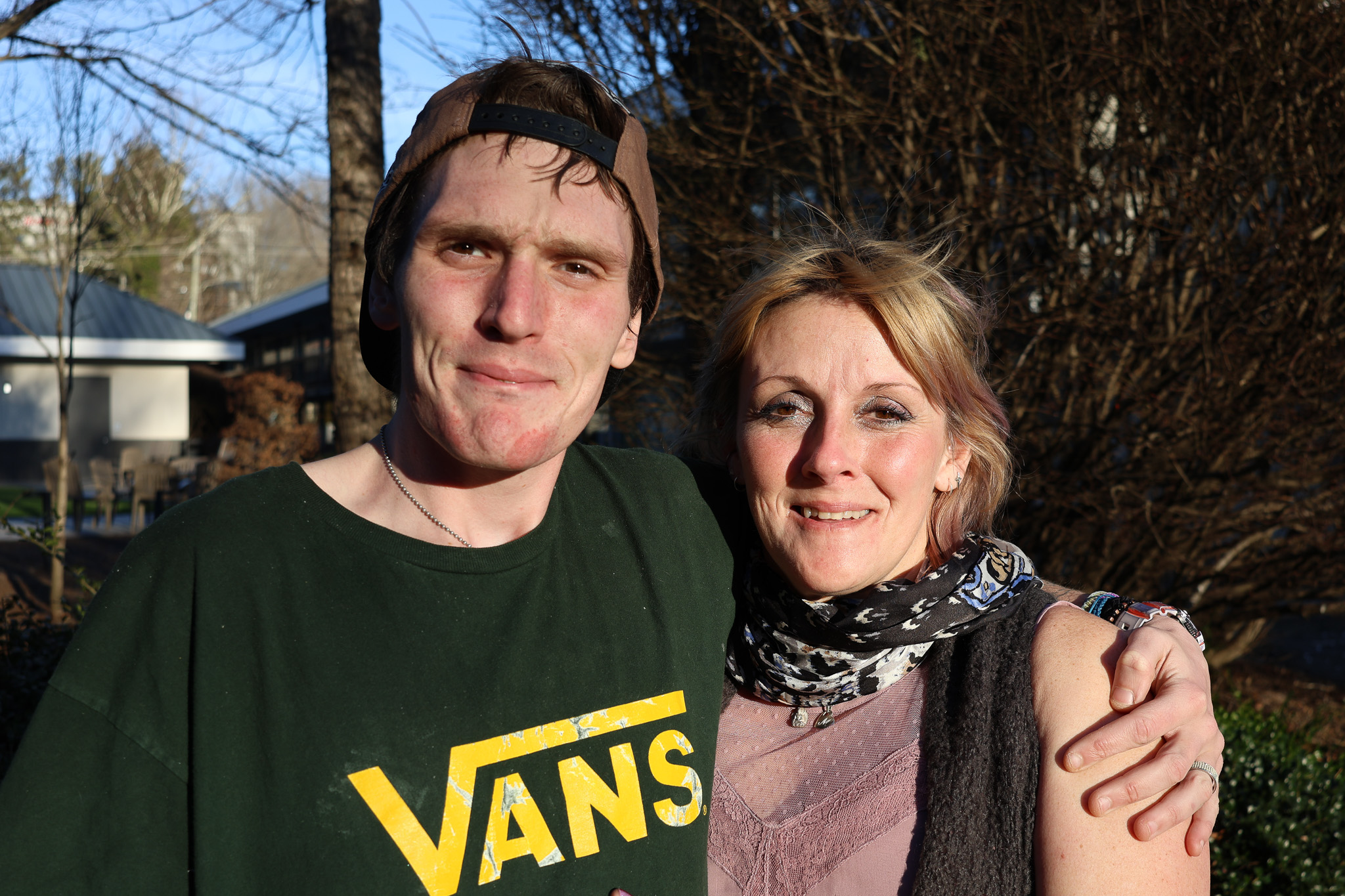
Brooke and Kelso met on the streets of Asheville. Their paths had crossed once or twice, but it wasn’t until one freezing morning on a bus that they connected. Brooke noticed Kelso sitting alone, wearing only shorts and a T-shirt. From his expression, she could tell something was wrong. She handed him a sweater, an extra she didn’t know why she had that morning, and felt she couldn’t leave his side until she knew he would be okay. Soon after, they began dating and surviving on the streets together.
Brooke
Brooke was born and raised in North Carolina. After her parents’ separation, she moved frequently as her mother remarried. Her father’s addiction and her mother’s focus on her career left Brooke feeling deprived of love and affection. She describes her upbringing as a “typical broken family: divorce and alcoholism.”
As a young adult, Brooke watched her friends marry, have children, and build their own lives. She entered her 20s hoping to do the same. She graduated from college, became a registered nurse, and bought her first apartment at 24. While she valued her independence, the pressure of maintaining her mortgage quickly became overwhelming.
“I was always stressed about money,” Brooke says. “Even as a nurse making $50,000 a year, I was constantly worried about how I was going to make it. I always felt two weeks away from losing everything…Homeownership in America is not what it used to be.”
Brooke took a huge blow to her stability when her fiancé walked out on her. Not long after, her sister was diagnosed with cancer, and her grandmother passed away. Then, after being bitten by a venomous snake, Brooke was prescribed opioids to cope with the pain. The combination of these experiences and unresolved trauma led to Brooke developing an addiction. Under severe stress, she walked away from her mortgage and became homeless.
Kelso
Kelso grew up in a low-income neighborhood in Baltimore, Maryland. From an early age, he experienced violence, addiction, and poverty. He remembers being shot when he was 12 years old and waking up on a table with a tag on his foot. He also remembers his mother struggling with addiction, and his stepfather telling him that selling drugs was the only way to help his family.
“We moved every six months to a year,” Kelso says. “We were always getting evicted. I had six siblings, and we were all starving. I got tired of seeing my younger brother and sister go hungry, wearing the same clothes.”
At 14, Kelso was arrested for selling drugs and sent to a juvenile detention center. His mother and father told him he couldn’t come home when he was released. Without a place to stay, Kelso train-hopped across the country with other teens with similar backgrounds. He said traveling was liberating and thrilling until he was involved in a severe car accident that resulted in multiple surgeries on his back and knees. The physical and emotional pain caused years of depression.
He eventually made his way to Asheville, where he has lived for the last 10 years. Two years ago, his mother and aunt passed away within months of each other. After learning of his mother’s death over the phone, he felt at his lowest point and took a bus to a mental health clinic. That’s when he met Brooke.
Together
As a couple, Brooke and Kelso slept wherever they could in Asheville. Often, they were moved along by police and fined for trespassing. While homelessness itself is not a crime, local ordinances can make it nearly impossible to find a safe place to sleep outside. Outside of Code Purple season, which offers night shelter during the winter, shelters typically only have space for one person from a couple. Most people aren’t comfortable leaving their partners while they sleep surrounded by strangers.
In the final months before being housed, the couple was permitted to live in a shed behind an office building. For the first time in a while, they had a place to rest. They could lock the door and protect both their belongings and themselves.
After connecting with the AHOPE Day Center, Brooke and Kelso were slated for Permanent Supportive Housing at Compass Point Village. They received a call from Luc Gay, Homeward Bound’s Coordinated Entry Program Manager, telling them they could move in that week. The couple signed their first lease together on Brooke’s birthday.
Seven months later, Brooke and Kelso are settling into their new home. They access medical and behavioral healthcare through Appalachian Mountain Health, our on-site medical partner. Their case manager, Erin, is helping connect Brooke to disability benefits. More than anything, both of them want to work. Brooke is driven to earn her own income so she can pay rent. For now, they are focused on allowing their nervous systems time to reacclimatize.
“They’re both pretty grounded,” says Erin. “Their situation reflects well what happens when you’ve been houseless for a number of years. It can be overwhelming and a little claustrophobic.”
In their personal lives, Brooke says she felt starved for information while living on the streets and now watches YouTube videos to catch up on what she missed. She dreams of starting a food truck for music festivals, inspired by her teenage years as a roadie for the Grateful Dead. What matters most to her now is healing from the trauma she has experienced and the relationship she has built with her case manager.
“This goes very deep for me,” says Brooke. “Erin cried when she got us into the apartment. Nobody has ever shown that kind of emotion to help someone they didn’t even know. Her heart is in it.”
Kelso enjoys skateboarding and playing guitar. Both of his parents have passed away, which has been very hard for him. He encourages everyone to call their parents every day if they have the opportunity. What matters most to him is Brooke’s safety and well-being.
“It’s a relief,” he says. “It’s nice knowing that no matter what, she has housing more than anything.”